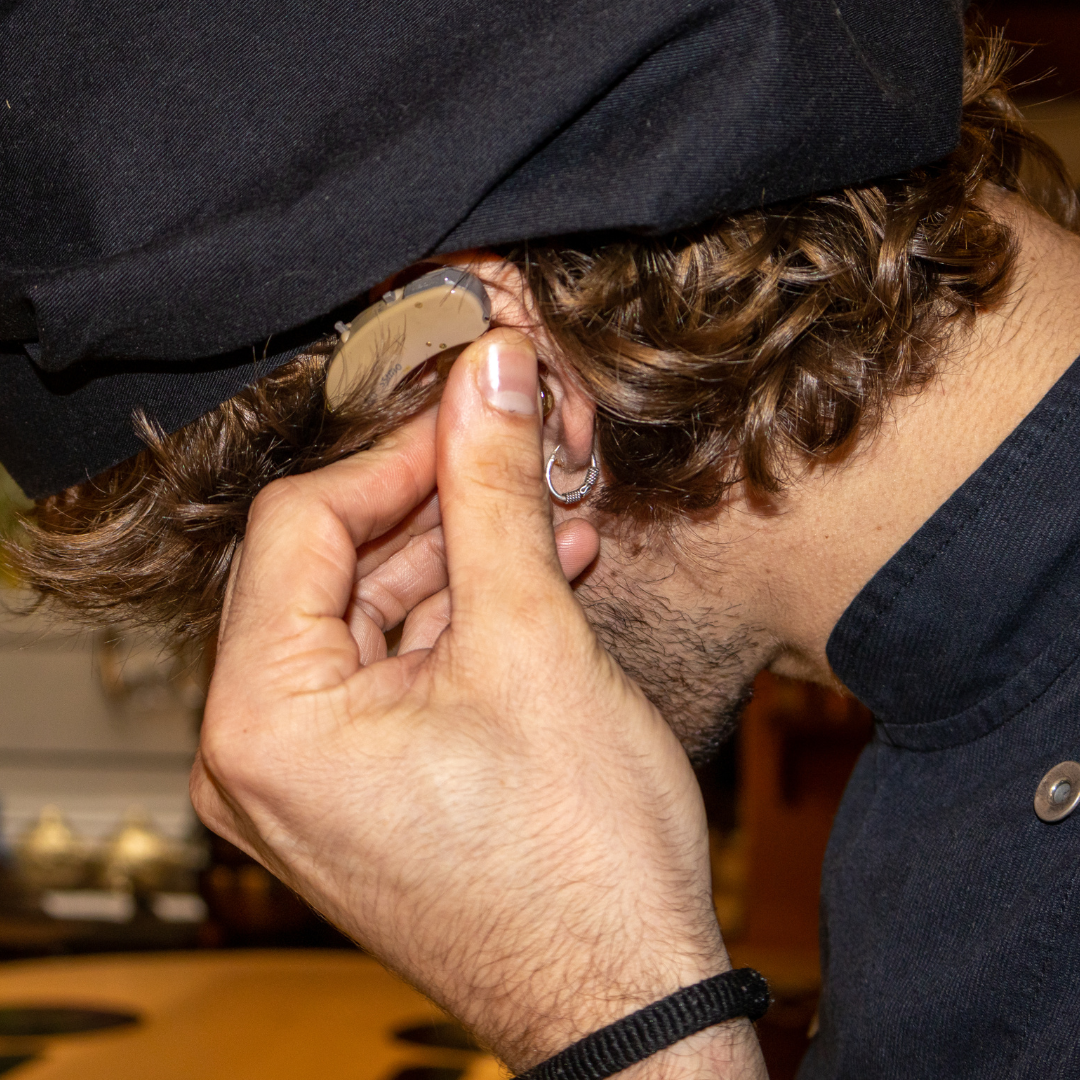
Active restaurant conversations are frequently hard to decipher when surrounding background noise clashes with your hearing. Our practice provides targeted diagnostics to evaluate hearing in quiet atmospheres as well as complex noise environments. After uncovering the precise factors driving your difficult hearing, our team helps you select individualized auditory solutions.
Understanding the Contrast Between Quiet Hearing and Restaurant Noise
A quiet setting creates an optimal signal-to-noise ratio, ensuring the conversational partner’s voice rises cleanly above ambient sounds. Restaurants create the opposite situation. Competing conversations, background music, tableware clatter, and acoustic reflections clash with incoming speech, making auditory processing exceptionally strenuous.
These communication barriers frequently indicate high-frequency hearing loss, central auditory-processing disorders, or age-related sensorineural changes. Visual limitations from low lighting, cognitive fatigue, and sitting farther away from conversational partners amplify speech degradation. It is common to display normal baseline audibility on conventional hearing tests while failing comprehensive speech-in-noise testing. Inability to track speech in crowded restaurants merits audiological evaluation even when standard daily hearing sounds completely normal.
How Audiologists Identify High-Frequency Hearing Loss
We begin with a history of the situations that cause trouble, along with questions about noise exposure, tinnitus, medications, family history, and changes in either ear.
Pure-tone audiometry measures the softest sounds you can hear at different pitches through air and bone conduction. High-frequency loss often creates an audiogram pattern in which thresholds become poorer as pitches rise. Further clinical diagnostics feature tympanometry to evaluate eardrum and middle-ear mechanics as well as word-recognition testing for speech comprehension.
A quiet sound booth cannot replicate complex dining room acoustics, which makes clinical speech-in-noise testing especially informative. It evaluates sentence-level speech comprehension as competing background babble increases in volume. In combination, these diagnostic metrics reveal whether communication hurdles involve audibility thresholds, speech discrimination, neural noise management, or mixed conditions.
Auditory Processing Disorders: Impact on Adult Communication
An auditory processing disorder compromises how the central auditory pathways and brain decode incoming acoustic information. The peripheral auditory system may register sounds within normal limits, yet the brain falters when separating competing acoustic inputs, sorting speech sounds, or tracking fast speech. We systematically verify peripheral hearing health before establishing whether an advanced auditory-processing evaluation or medical referral serves your needs.
Actionable Listening Tips for Noisy Social Settings
Simple situational adjustments enhance the speech signal entering your ears and offer clearer facial cues. Before dining out, choose a quieter restaurant or visit during an off-peak time. Dining locations utilizing sound-absorbing elements like booths, felt panels, window curtains, and carpet offer better acoustics than high-ceilinged rooms with hard surfaces.
At the restaurant:
- Ask for seating positioned far away from open kitchens, noisy bar areas, ceiling speakers, and large parties.
- Choose a seat with your back against a solid wall to block acoustic clutter originating from behind.
- Position yourself directly opposite your companions where direct lighting highlights their facial expressions.
- Keep conversational proximity as close as comfortably feasible to preserve acoustic signal strength.
- Direct your better-performing ear toward the companion you most need to understand.
- Prompt companions to rephrase unclear sentences with alternate terminology instead of repeating identical words.
- Explicitly repeat back important logistical details instead of pretending you caught every word.
- Allow yourself a short listening respite when auditory concentration starts to feel drained.
- Ask dinner guests to speak with clear enunciation at a steady, natural conversational rate.
- Shouting can distort speech and does not necessarily make words easier to understand.
Advanced Technology for Hearing in Background Noise
The best technology depends on the cause of the difficulty, the listening environment, and whether hearing loss is present. Customized hearing aids employ directional microphone beamforming, noise cancellation algorithms, and targeted dining programs to prioritize speakers in front while lowering ambient noise. They still require realistic expectations because no device can remove every unwanted voice.
Wireless remote microphones provide the most effective enhancement to real-world signal-to-noise ratios. The accessory is worn on the lapel or set near the speaker, streaming their voice directly into compatible hearing aids or wireless audio receivers. By streaming directly, this technology overcomes acoustic falloff from distance and surrounding environmental noise.
Supplementary auditory solutions include:
- Multi-directional table microphones designed for small dinner gatherings
- Hearing-loop telecoils that stream clean audio in loop-equipped establishments
- Real-time smartphone speech-to-text transcription and live-captioning apps
- Modern wireless hearables delivering directional beamforming and sound enhancement
- Sound-level or restaurant-review tools for finding quieter locations
We can compare options, confirm compatibility, and teach you how to use the selected device.
Professional Audiological Solutions for Loud Listening Environments
Clinical hearing evaluations progress the diagnostic process past the typical assertion that hearing is adequate in quiet. Our clinicians review the specific environments, vocal pitches, and decibel levels that trigger breakdowns to design a personalized test protocol. Your comprehensive workup may involve pure-tone hearing thresholds, middle-ear testing, recorded word recognition, and speech-in-noise measures. Central auditory-processing testing is considered whenever clinical intake and initial test outcomes point toward higher-order deficits.
Rapidly progressing, asymmetrical, or sudden hearing decline warrants an urgent clinical referral to an ear, nose, and throat physician. Tailored audiological treatment identifies the exact origin of listening breakdown rather than assuming environmental dining noise is the sole culprit.
Schedule a Diagnostic Hearing Evaluation Right Away
If restaurant conversations leave you guessing, withdrawing, or feeling exhausted, schedule a comprehensive hearing evaluation with us. We can evaluate targeted solutions to optimize your hearing in noisy environments using prescription hearing aids, assistive listening technology, or communication strategies tailored to you.
Contact our audiology office today to schedule your evaluation and move toward effortless, confident conversations.
